Description
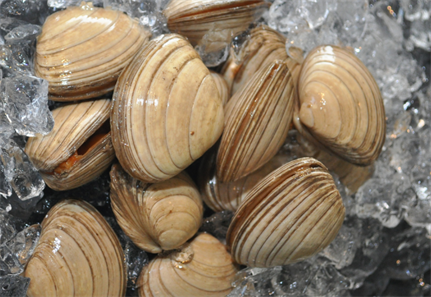
A marine and estuarine bivalve mollusc with a rough cream, greyish white, pale yellow or light brown shell with sculptured concentric ridges, often with darker patterning and pink, orange or blue tinges near the hinge. They are found around the south-eastern Australian coast (including Tasmania) and harvested by hand in NSW from sand and silt along coastlines with moderate current flow, sometimes off ocean beaches and often near beds of Posidonia seagrass.
Price
Medium priced.
Relations
Pipi (distinguished by smooth shell), Sydney Cockle (distinguished by prominent outward-radiating ribs) and Vongole (distinguished by oval shell). Surf Clams belong to the same family as the American Quahog or Hardshell Clams, and Mediterranean Warty Venus, Carpet-Shell Clam and Smooth Venus.
To Buy
Sold live. Look for brightly coloured, intact, lustrous shells, that are closed or close when tapped or gently squeezed, and a pleasant fresh sea smell.
Due to their sandy habitat they can contain a bit of grit, ask your fishmonger if they have been purged (stored in aerated saltwater for at least 24 hours to eliminate sand), if they haven’t been, see below for purging instructions.
To Store
Clams should be consumed as soon as possible after purchase. Place in a container, cover with damp cloth or butcher’s paper and keep in the warmest part of the refrigerator, usually the crisper (optimum 5°C), ensuring the covering remains damp. Before cooking, discard any shells that are open and don’t close when tapped or gently squeezed. Freeze meat for up to 3 months below -18ºC.
To Cook
If Clams haven’t been purged, place them in a solution of cool water and sea salt (30g salt to each litre of water) for several hours, or overnight, at room temperature (if you refrigerate them they’ll close up and won’t ‘spit out’ the sand).
Average yield is 30%. They have a medium flavour, medium oiliness and moist, firm flesh. Remove from the heat as soon as they open, as they quickly shrivel and become chewy if over cooked.
While traditional wisdom was to discard shells that don’t open when cooked, you can pry them open, away from the plate, and, if they smell good, eat them; if they’re bad, they’ll have a distinctly ‘off’ aroma.
Cooking Methods
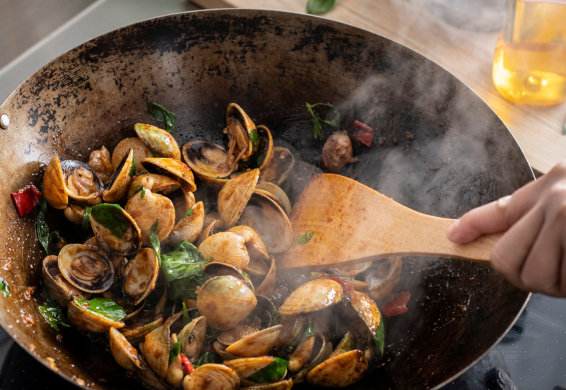
Steam, poach, stir-fry, bake, grill, barbecue, smoke, raw (sashimi), pickle. The firm flesh works well in soups, curries and stir-fries.
Goes Well With
Chilli, coriander, garlic, parsley, tomato, white wine.
Imports
They have been imported, frozen, from New Zealand, where they’re known as Little-Neck Clams.