Description
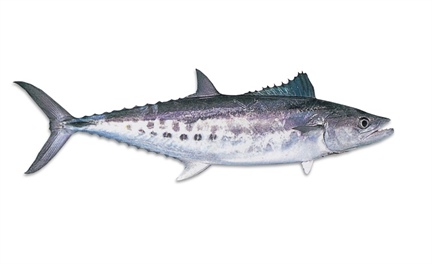
Available wild-caught, it is a marine fish schooling in open waters, and sometimes moving in to inshore bays and estuaries, around the northern half of Australia from Newcastle (NSW) to Shark Bay (WA). Mainly caught off Queensland and the NT, it looks like a small Spanish Mackerel but with distinctive large grey spots on the back half of the body, though these begin to fade once the fish is caught. The similar Spotted Mackerel has smaller spots along the sides.
Price
Medium priced.
Relations
Mackerels (Blue, Frigate, Grey, Shark, Spanish, Spotted), Bonito, Tunas.
To Buy
Sold mainly as cutlets and steaks. In cutlets and steaks look for bright whitish-pink, firm, lustrous, moist flesh without any dark brown markings or oozing water and with a pleasant fresh sea smell.
To Store
Make sure whole fish is scaled, gutted and cleaned thoroughly. Wrap whole fish, fillets and cutlets in plastic wrap or place in an airtight container. Refrigerate for up to 2 days (it is best eaten as fresh as possible) or freeze for up to 3 months below -18ºC.
To Cook
Average yield is 40%. Has a strong, distinctly ‘fishy’ flavour, medium to very high oiliness and medium-dry, firm flesh. Usually sold skinned, it has few bones, which are easily removed. Score thick fillets at the thickest part of the flesh to allow even heat penetration.
Cooking Methods
Pan-fry, bake, grill, barbecue, smoke, pickle.
Goes Well With
Strong flavours, bay, basil, citrus, curry, garlic, mustard, onion, oregano, pepper, red wine, tomatoes, vinegar.
Imports
None, though Spanish, Atlantic (Scomber scrombus), and occasionally Chub (Scomber japonicus), Mackerels are imported frozen, whole and in fillets, smoked and canned in various forms (such as rollmops).