Description
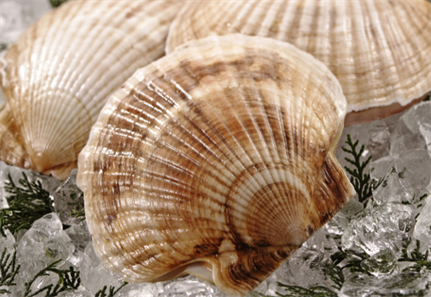
This bottom-dwelling saltwater bivalve, is found in open water and available wild-caught. There are 2 main varieties, Northern and Ballot’s, both with almost round, flat shells, the top being distinctively smooth with concentric circular bands of browny reds, darker towards the outside edge.
They occur around most of the Australian coast (except from Esperance, WA, east to Sydney). The Ballot’s is trawled mainly off Queensland (north of Torquay), with some coming from Shark Bay and south-western WA. The Northern is a bycatch of coastal trawling (mainly for Prawns) and is mostly exported to South East Asia and the USA.
Price
High priced.
Relations
The other main Scallop found in Australia is the Commercial Scallop, distinguished by its oval shell with 2 equal sized wings at the base (the classic Scallop shell shape), radiating ridges on the top shell and a sculptured (‘scalloped’) outer edge.
To Buy
Usually sold as Scallop meat (by the kilo) or on the half shell (by the piece), with roe removed. Look for firm, intact, lustrous flesh and shells, with a pleasant fresh sea smell.
Raw Scallop meat should be translucent and slightly ‘sticky’ indicating that it is ‘dry’, meaning it hasn’t been frozen or stored in water.
If buying live Scallops, shells should be closed or close when tapped or gently squeezed.
To Store
Refrigerate for up to 3 days or freeze for up to 3 months below -18ºC. Live molluscs should be consumed as soon as possible after purchase. Place in a container, cover with damp paper or cloth and keep in the warmest part of the refrigerator, usually the crisper (optimum 5ºC), ensuring that the covering remains damp.
To Cook
Average yield in half-shell is 15% (roe off); off the shell it is 100%. Has a rich flavour, low oiliness and moist, medium-firm flesh; they tend to be firmer than Commercial Scallops. The flesh is white and translucent when raw, turning opaque when cooked.
Cooking Methods
Steam, poach, deep-fry, pan-fry, stir-fry, bake, grill, barbecue, raw (sashimi). Scallops require even less cooking than most seafood. It is always better to undercook, rather than overcook, them, leaving the centre still translucent, as they will continue to cook in the residual heat once they are removed from the pan.
Perfectly cooked, they are sweet and succulent with a gentle firmness, overcooked they are shrunken, tough and tasteless.
Goes Well With
Avocado, breadcrumbs, butter, cauliflower, chilli, coriander, cream, dill, garlic, ginger, lemon, lime, mayonnaise, olive oil, Pernod, sesame, soy sauce.
Imports
Frozen Scallop meat (sometimes roe on) is imported from Asia, New Zealand and North America. Farmed South American bay scallops (Argopecten purpuratus) are imported frozen on the half shell from Peru. Dried Scallop meat (con poy) is imported from Asia, where it’s considered a delicacy.