Description
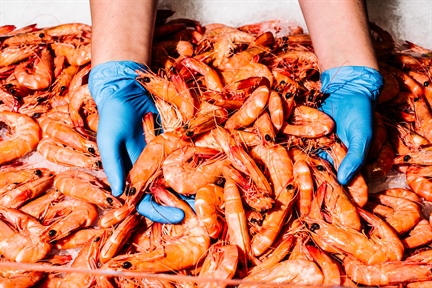
Have a cream to light brown body, with legs and tailfin a distinctive bright blue in the Western and cream in the Eastern. Redspot has a distinctive red spot on each side of the body shell.
Available wild-caught, these are marine and estuarine-dwelling Prawns, with adults found offshore on a range of bottoms (rock, sand, mud and gravel) to depths of over 220m, and juveniles preferring estuaries or shallow coastal waters.
Western have the widest distribution, found around the Australian coast except for NSW, Victoria and Tasmania and mainly trawled at night off SA and WA, but also off NT and Queensland.
Eastern are found from Bass Strait east to Rockhampton and are an important fishery off Queensland and NSW, and to a lesser extent Victoria.
Redspot are found around the northern Australian coast from Rockhampton to Shark Bay, WA, usually near coral reefs, and are trawled at night, mainly along Queensland’s eastern coast as far north as Cape York.
Price
High priced, with larger prawns fetching the highest prices and Western and Redspot generally cheaper than Eastern.
Relations
Other Penaeidae Prawns, such as Banana and Tiger Prawns.
To Buy
Look for brightly coloured, firm, intact, lustrous shells, without any discolouration, particularly at joints, and a pleasant fresh sea smell. Prawns are highly perishable in their raw state and so are often frozen or boiled at sea as soon as they are caught.
If cooking with Prawns, buy green (raw) Prawns, as cooked Prawns will toughen if reheated.
To Store
Leave Prawns in their shells until just before using and store them in an airtight container in the refrigerator for up to 3 days or freeze for up to 3 months below -18ºC. Once thawed, frozen Prawns should not be refrozen.
To Cook
Average yield is 45%. Has a rich flavour, low-medium oiliness moist flesh with a medium-firm texture. Flesh is translucent when raw and white with pinkish bands when cooked.
After removing the head from a fresh green Prawn, hold the Prawn straight and gently pull the end of the digestive tract (from the head end), it will usually come out in one go. If it breaks off, use a thin skewer to hook it out from the back.
In cooked Prawns, cut the back open to remove the digestive tract.
Cooking Methods
Steam, poach, deep-fry, pan-fry, stir-fry, grill, barbecue. The firm flesh holds together well in soups and curries and threaded on skewers for kebabs.
Like all seafood, Prawns require very little cooking. It is always better to undercook, rather than overcook, them, as they will continue to cook in the residual heat. King Prawns have a particular tendency to become tough if not handled correctly.
Goes Well With
Butter, chilli, garlic, ginger, herbs, lemon, lime, mayonnaise, olive oil, salad greens, soy sauce, tomato.
Imports
Similar species are imported, mainly from South East Asia. Vannamei Prawns (Litopenaeus vannamei) and Paradise Prawns (Litopenaeus stylirostris) are two of the most common imported prawns.